



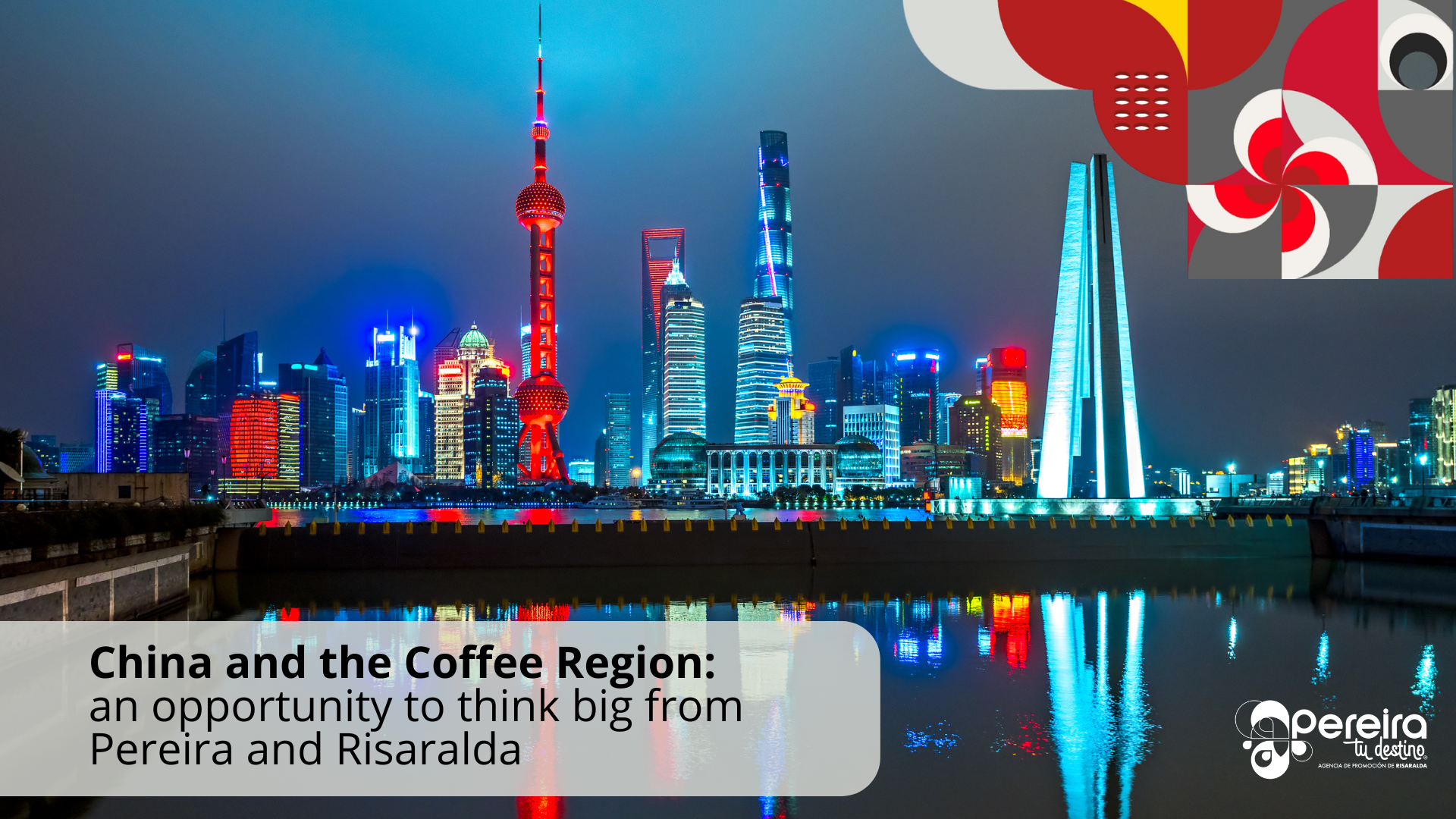
The upcoming Foreign Trade Summit, organized by Pereira Tu Destino, led by its foreign trade coordination team, will place China at the center of the conversation. More than focusing on a guest country, this is about understanding what Pereira, Risaralda, and the Coffee Region can learn from and build with one of the most dynamic business ecosystems in the world.
The event, which will take place from June 2 to 4, will include a trade showcase, a special encounter with China featuring project presentations by several Chinese companies, and a business matchmaking round. In other words, this is not only about talking about China. It is about creating concrete spaces for connection, learning, and business opportunities.
Why China matters today
China has become a global benchmark because it has managed to combine three key factors: scale, innovation, and long-term strategy. That combination has allowed it to move, in just a few decades, from an economy focused on basic manufacturing to one that now leads sectors such as technology, e-commerce, infrastructure, and logistics.
For many Colombian companies, and especially for those in the Coffee Region, that trajectory is
valuable not only because of what it can mean in terms of market access, but also because of
what it represents as a business lesson. In a much more demanding environment, having a
good product is no longer enough. Competing today requires greater efficiency, faster
innovation, stronger commercial capabilities, a better understanding of new channels, and a
much more ambitious vision for growth.
What the Chinese ecosystem can teach companies in the region
Companies such as Alibaba and Huawei represent something deeper than size. They reflect a business mindset built for growth, supported by technology, driven by global ambition, and shaped by adaptability. In the case of COSCO, the message is just as clear: efficiency is not simply an advantage. It is a condition for competing.
Reducing lead times, optimizing processes, lowering logistics costs, improving commercial
channels, and increasing responsiveness all have a direct impact on margins, market share,
and long-term sustainability.
That lesson is especially relevant for the Coffee Region.
The region has real strengths. It benefits from a strategic location, an active business base, and a diverse offer in sectors such as agribusiness, coffee, tourism, and manufacturing. It also has a recognizable territorial identity and strong differentiation potential in international markets.
At the same time, it faces an important challenge: many companies are still operating with
traditional structures in a world that increasingly demands agility, stronger technological
integration, and a broader vision of growth.
The challenge for Pereira and Risaralda
For Pereira and Risaralda, engaging with China should not be seen only as a search for investment or buyers. It should also be understood as an opportunity to rethink how the territory approaches competitiveness.
The key lesson is that competitive advantage no longer comes only from the product itself. It
comes from the entire system around it: logistics, packaging, commercial storytelling, digital
channels, data management, market access, productivity, and expansion capacity.
That shift in mindset is especially important in a region where there are already high-quality
products and valuable capabilities, but where there is still room to strengthen scale, commercial
sophistication, and international vision.
A conversation that matters for the territory
That is why placing China at the center of this Foreign Trade Summit is so meaningful. It is not simply about inviting an important global player. It is about opening a conversation that matters for the territory.
It matters for Pereira, because it reinforces its role as a city that connects opportunities,
knowledge, and business. It matters for Risaralda, because it helps project a more international
vision of its business ecosystem. And it matters for the Coffee Region, because it pushes
forward a necessary conversation about productivity, scale, and transformation.
The relationship with China can open commercial doors, attract business interest, and create new links. But even beyond that, it can help raise an important question for the future of the region:
Are we thinking about our companies and our territory with the ambition, efficiency, and vision that today’s world demands?
The Foreign Trade Summit may be the right place to begin answering that question.

Comentarios de los usuarios
Deja tu comentario: