



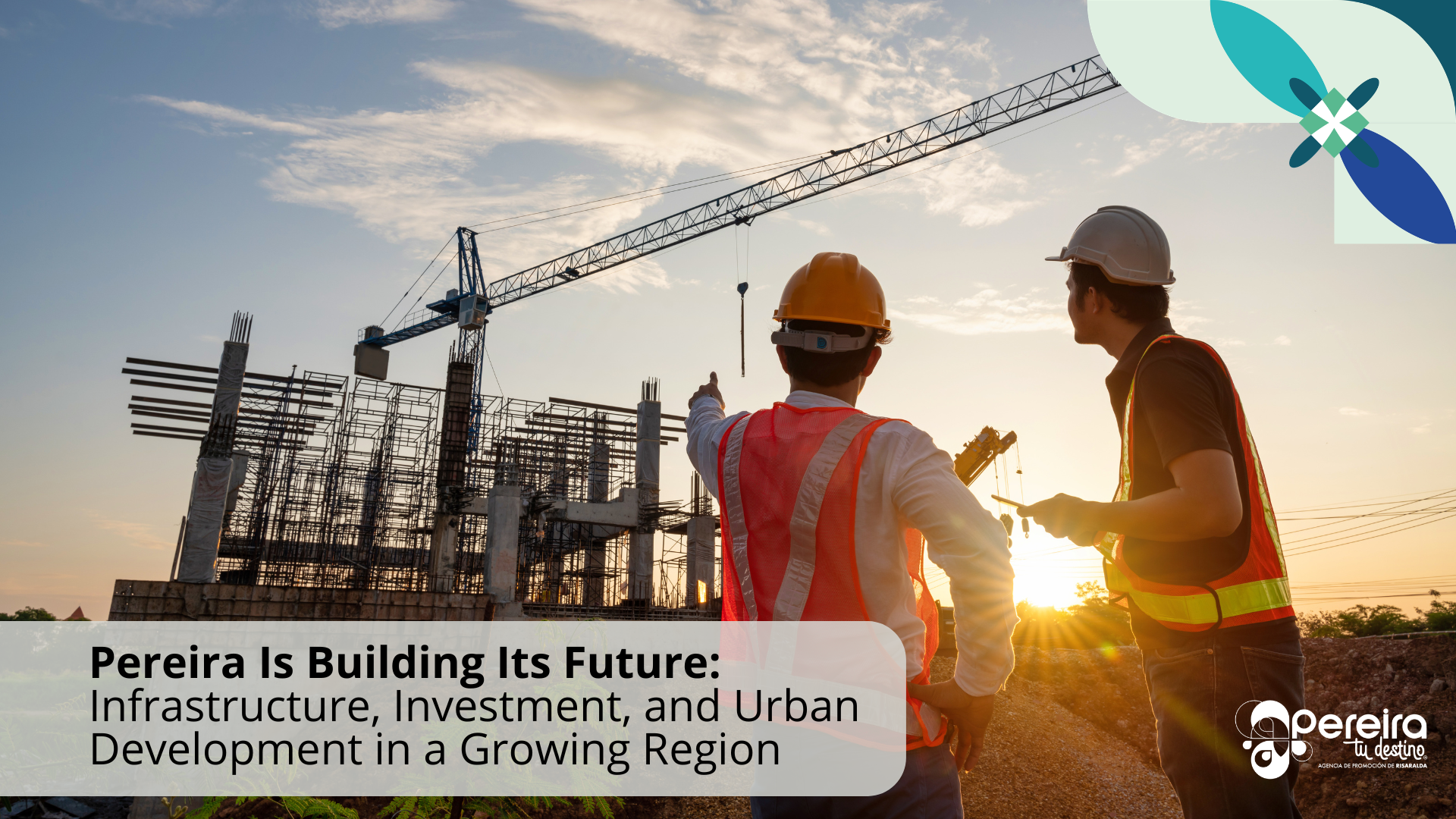
A City That Reflects Confidence and Transformation
Pereira is at a key moment to think about its urban future, its infrastructure, and its role in Colombia’s regional development. In recent years, the city has faced important economic challenges, especially in sectors such as construction and housing. At the same time, it has consolidated advantages that position it as an attractive territory to live, invest, and develop new projects.
This was one of the main reflections from the Pereira Tu Destino webinar with Felipe Mejía Lamprea, General Manager of Proyectos Urbanos, Board President of Camacol Risaralda, and city developer behind Ciudad Bocorá in Pereira. The conversation made it clear that construction is not only about buildings, housing, or physical projects. It is also a sign of confidence, employment, investment, urban transformation, and long-term vision.
When a city builds, it also communicates that it is growing. And when that growth is connected to infrastructure, connectivity, quality of life, and planning, it becomes an opportunity to attract investment and strengthen territorial competitiveness.
Construction as an Economic Driver
The construction sector has a deep impact on the regional economy. Behind a home, a hotel, a warehouse, a business center, or an urban project, there are architects, engineers, suppliers, labor, materials, transportation, services, financing, commerce, and multiple productive linkages.
That is why construction is one of the sectors that best reflects the level of confidence in an economy. When people buy homes, when companies develop projects, and when investors commit to new urban uses, a value chain is activated far beyond the physical construction site.
During the webinar, Felipe Mejía explained that the sector has gone through complex years. Interest rates, changes in demand, economic uncertainty, and difficulties in the affordable housing segment have affected the pace of sales and new developments. However, he also pointed out that the sector still has enormous potential if confidence, stability, and conditions for investment are restored.
Pereira Became More Attractive After the Pandemic
One of the most important changes in recent years has been the way many people began to see Pereira as a city to live in. After the pandemic, remote work, the search for better quality of life, and the possibility of staying connected to the country’s main economic centers gave the city greater visibility.
Pereira offers a balance that is difficult to find: a pleasant climate, a manageable urban scale, air connectivity, proximity to Bogotá, Medellín, and Cali, a solid educational offer, services, gastronomy, nature, and a quality of life that appeals to families, professionals, entrepreneurs, and people looking for a place to settle or invest.
This new appeal also has an impact on real estate dynamics. The arrival of residents from other cities, interest in second investments, and the growth of formats such as short-term rentals, apart-suites, and mixed-use projects show that the city is entering a new stage of urban development.
Infrastructure to Support Growth
The growth of Pereira and Risaralda cannot be understood without talking about infrastructure. In recent decades, the city has improved its regional connections, its relationship with neighboring municipalities, and its access to strategic corridors across the country.
Felipe Mejía highlighted how travel times to cities such as Armenia and Manizales are now shorter than they were a few years ago. He also noted that Pereira has made progress in public space, facilities, public services, and urban works that improve the city’s quality of life, although important challenges remain before reaching optimal infrastructure levels.
These challenges include the need to strengthen road connectivity, improve mobility toward new expansion areas, advance public services, develop the wastewater treatment plant, expand urban facilities, and consolidate an urban offer that responds to the city’s growth.
Infrastructure does not only solve needs. It also creates conditions for investment. A better-connected city, with stronger services and the capacity to plan its growth, is a more attractive city for companies, urban projects, investors, and new residents.
Strategic Location as a Competitive Advantage
Pereira has an advantage that appears constantly in conversations about investment: its location. The city is at the center of the Coffee Region and connects with Colombia’s main markets. Its relationship with Bogotá, Medellín, Cali, Buenaventura, the Caribbean, and the western corridors of the country makes it a strategic point for business, logistics, commercial, and tourism operations.
This position is not only a geographic fact. It is an economic opportunity. In a country where transportation times, proximity to markets, and logistics efficiency are decisive, Pereira and Risaralda can consolidate themselves as a platform for companies seeking to serve different regions from an intermediate, competitive, and well-connected location.
The growth of warehouses, logistics centers, projects along corridors such as Cerritos, La Virginia, Cartago, and Armenia, as well as the presence of the Pereira International Free Trade Zone, reinforces this view. The region has the conditions to continue attracting logistics infrastructure, productive investment, and developments related to distribution, commerce, and business services.
Urban Development with a Vision for the Future
One of Pereira’s greatest challenges is to grow in an orderly way. The city has demand, appeal, and opportunities, but it also needs to balance development, sustainability, land availability, environmental protection, and quality of life.
Land-use planning will be key to defining how and where Pereira can grow. The conversation made it clear that the challenge is not to stop development, but to guide it better. A growing city needs housing, roads, public space, services, facilities, culture, commerce, and productive areas. But it also needs to protect its environment and make responsible decisions about its urban model.
This balance will shape an important part of Pereira’s future as a competitive intermediate city. Well-planned growth can strengthen the economy, attract investment, and improve quality of life. Disorderly growth, on the other hand, can widen gaps, pressure public services, and affect the sustainability of the territory.
Ciudad Bocorá: A New Way to Think About the City
One of the most representative cases of this new urban stage is Ciudad Bocorá, a project located across from Matecaña International Airport that aims to become a mixed-use development with a hotel, apart-suites, a business center, commercial areas, logistics spaces, and public-use zones.
The project is based on a strategic idea: to take advantage of a privileged location to create a new urban node connected to the airport, the city, and Pereira’s business, tourism, and logistics dynamics. It is not only about constructing buildings, but about creating a space capable of responding to new ways of traveling, working, investing, and temporarily inhabiting the city.
Ciudad Bocorá also reflects an increasingly relevant global trend: urban projects can no longer be conceived in isolation. They must be integrated with mobility, sustainability, services, urban experience, and economic vocation. For Pereira, this type of development can help raise its profile as an intermediate city with the capacity to receive investment, visitors, companies, and new business formats.
Pereira as a Next Investment Destination
The conversation with Felipe Mejía left a clear message for investors, business leaders, and citizens: Pereira has real conditions to keep growing.
The city has a strategic location, air and land connectivity, a favorable climate, friendly topography, a diverse economy, quality of life, and an open culture that welcomes those who arrive. It also has institutions working to facilitate investment and support new projects in the territory.
These advantages allow Pereira and Risaralda to consolidate themselves as an attractive destination for urban projects, infrastructure, housing, logistics, tourism, services, and business development. The key will be to maintain confidence, strengthen planning, and coordinate efforts among the public sector, private sector, business associations, and institutions.
Building a City Means Building Opportunities
Talking about construction and infrastructure means talking about Pereira’s future. It means talking about employment, investment, mobility, housing, logistics, tourism, quality of life, and competitiveness.
The region faces important challenges, but it also has a clear opportunity: to continue consolidating itself as a growing territory, with urban vision, business capacity, and conditions to attract new investment.
From Pereira Tu Destino, these spaces open strategic conversations about the issues that shape regional development. Construction is not only an economic sector. It is a concrete way to project what a city wants to become.
Because when Pereira builds well, it also builds confidence, development, and new opportunities.



Comentarios de los usuarios
Deja tu comentario: